Money in Morocco: Cards, Dirhams, ATMs and Tipping
The Moroccan dirham (MAD) is a closed currency: you can neither buy nor sell it outside Morocco. That single rule shapes how you handle money on the ground — you'll arrive without dirhams, withdraw from an ATM, and need to spend or reconvert before you leave.
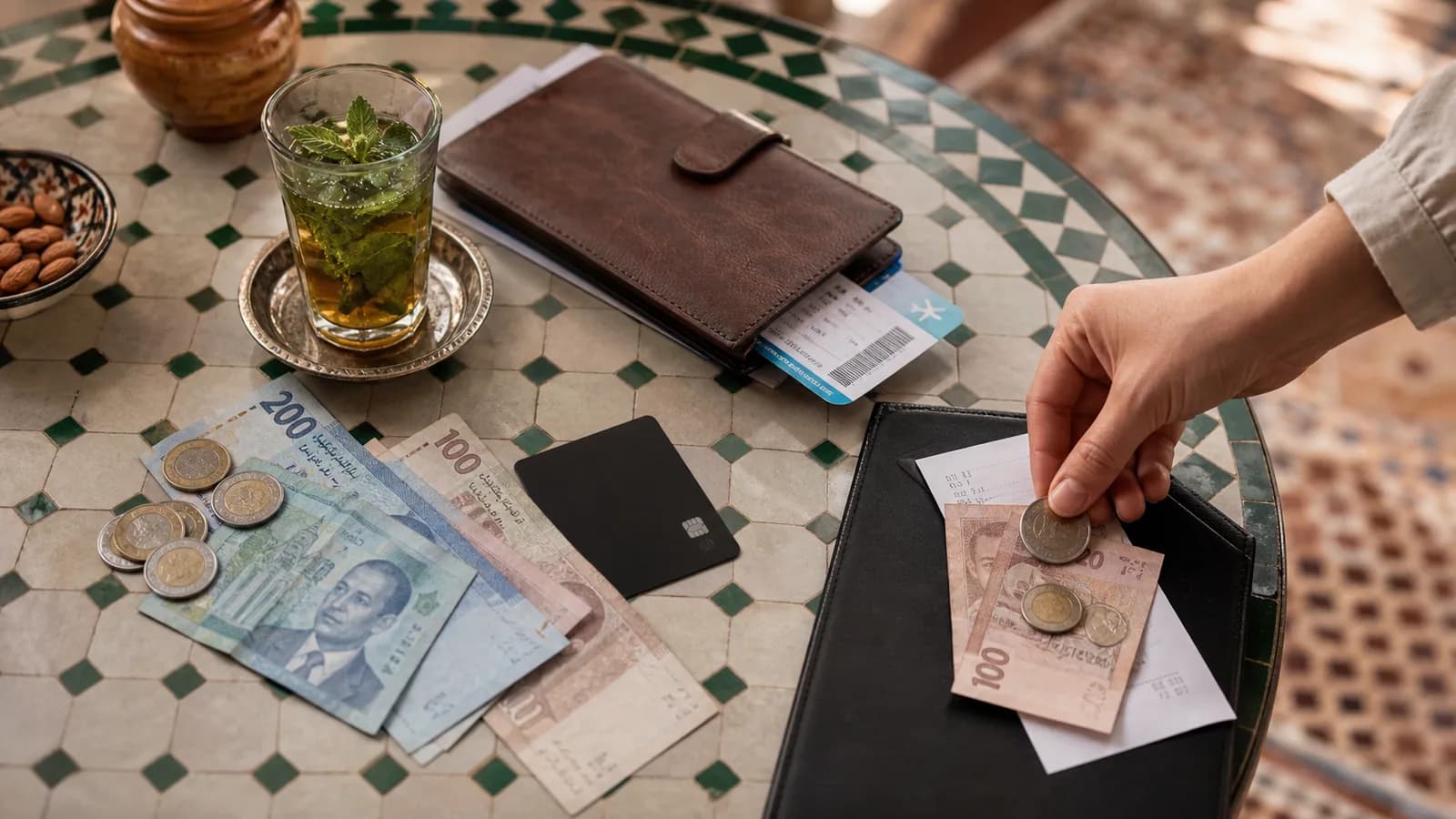
Because the dirham is closed, you get it on arrival: at an ATM or an exchange desk. Since January 2026, Moroccan banks charge a flat fee of about 35 MAD per withdrawal with a foreign card — there are no fee-free ATMs left. The cap is often 2,000 MAD per withdrawal (sometimes 4,000), but there is generally no daily limit on the number of transactions, so take the maximum in one go to dilute the fee. At the border, the official limit is 2,000 MAD in either direction. Cash remains essential for taxis, souks and tips. On payment terminals, always decline dynamic currency conversion (DCC): paying in euros or pounds rather than dirhams applies a rate that's invariably unfavourable. For tips, budget 5-10% at a mid-range restaurant, rounding up to the nearest 5 or 10 MAD for a petit taxi, and 10 MAD per bag for a porter.
The dirham is a closed currency
This is the starting point, and it catches many travellers out: you cannot exchange dirhams in your own country. There's no point asking your bank for MAD before departure — you'll get them on arrival.
The flip side matters too: the official limit for carrying dirhams across the border is 2,000 MAD in either direction. In practice, plan to spend or reconvert your dirhams before leaving rather than going home with a wad you can't use.
Withdrawing cash: what changed in 2026
This is the most important change for a traveller, and it's recent. Since January 2026, Moroccan banks apply a flat fee of around 35 MAD on every withdrawal made with a foreign card — Attijariwafa, Bank of Africa (BMCE), Banque Populaire, and now Al Barid Bank too, which used to be the fee-free option. There are no free ATMs left in Morocco.
That changes the tactic. Because the fee is flat rather than proportional, withdrawing 500 MAD costs the same as withdrawing 2,000:
| Amount withdrawn | Fee | Real cost of the fee |
|---|---|---|
| 500 MAD | ~35 MAD | 7% |
| 1,000 MAD | ~35 MAD | 3.5% |
| 2,000 MAD | ~35 MAD | 1.75% |
So take the cap in one go rather than making lots of small withdrawals. The per-transaction cap is usually 2,000 MAD, sometimes up to 4,000 depending on the bank. The good news: banks generally impose neither a daily transaction count nor a daily amount limit, so you can go again if you need to — but each withdrawal triggers the fee afresh.
On top of that come any fees from your own bank (currency conversion, foreign withdrawal charges). Check them before you go: that's where most of the difference between travellers actually lies.
Card or cash?
Cards work without trouble in hotels, upmarket riads, tourist restaurants, larger chains and petrol stations on the main routes.
Cash remains essential for everything else, and that's a big share of the trip: petit taxis, souks and medinas, neighbourhood cafés, guarded parking, tips, entry to some sites, street purchases. A cashless trip to Morocco isn't workable.
Decline dynamic currency conversion
The costliest and most discreet trap: when a terminal or ATM offers to charge you in euros or pounds rather than dirhams, it applies its own exchange rate, invariably in its favour. This is dynamic currency conversion (DCC). Always choose to pay in dirhams and let your own bank handle the conversion.
Tipping: how much, and when
Tipping is common in Morocco but not an automatic obligation. The commonly accepted ranges:
| Situation | Usual practice |
|---|---|
| Local café or small restaurant | A few dirhams, or round up |
| Mid-range restaurant | 5-10% if the service was good |
| Tourist restaurant | 10-15% |
| Petit taxi | Round up to the nearest 5 or 10 MAD |
| Longer transfer | 5-20 MAD depending on the trip |
| Porter | 10 MAD per bag, 20 in an upmarket hotel |
Two useful habits: check the bill first — some upmarket restaurants already include service — and tip in dirhams, far more practical for the recipient than a foreign currency.
Managing your money on the ground
Managing money in Morocco: 5 steps
A simple method to keep fees down and never end up without cash.
- Check your own bank's fees before you travelOn top of the 35 MAD taken by the Moroccan bank come your own institution's charges: currency conversion and foreign withdrawal fees. This is where the gap between travellers is widest.
- Withdraw on arrival, at the capSince the dirham is a closed currency, your first withdrawal happens at the airport or in town. Because the fee is flat, take the available cap — often 2,000 MAD — rather than several smaller amounts.
- Ask for small notes200 MAD notes are hard to break with taxi drivers, in souks and in small shops. Split into 20, 50 and 100 MAD notes as soon as you can.
- Always decline dynamic currency conversionIf a terminal or ATM offers to charge in your home currency rather than dirhams, decline: the rate applied is unfavourable. Always choose payment in local currency.
- Spend down or reconvert before departureThe official export limit is 2,000 MAD. Plan to spend the surplus or reconvert it at the airport exchange desk, keeping your withdrawal or exchange receipt in case you're asked for it.
Get online before you land· Airalo eSIM
Mistakes to avoid
To continue planning
- Morocco travel budget
- Safety and scams in Morocco
- Etiquette and customs in Morocco
- Renting a car in Morocco
Compare travel insurance· SafetyWing
Compare available cars· Discover Cars


